Introduction to Feng Shui
Feng Shui is an ancient Chinese practice focused on creating harmony between people and their surrounding environment. The term "Feng Shui" translates as "wind and water," reflecting the traditional belief that the natural environment influences the flow of energy, or Qi (Chi), around us.
Today, Feng Shui is commonly applied to homes, offices, gardens, and other spaces to create environments that feel balanced, comfortable, and supportive of wellbeing and prosperity.
Although different schools of Feng Shui use different methods, many approaches share several fundamental concepts, including Qi, Yin and Yang, the Five Elements, Bagua, directions, and the relationship between people and their environment.
What Is Feng Shui?
Feng Shui is traditionally understood as the study of how the arrangement and orientation of spaces interact with environmental energy.
A Feng Shui assessment may consider factors such as:
The orientation of a building
The location of doors and windows
The arrangement of rooms
Natural light and ventilation
The surrounding landscape
Furniture placement
Colors and materials
The Five Elements
Directional influences
The relationship between occupants and their environment
The goal is not simply to decorate a room according to a particular style. Instead, Feng Shui seeks to create a balanced environment in which energy can move naturally without becoming excessively stagnant or chaotic.
The Importance of Qi
One of the most important concepts in Feng Shui is Qi, often translated as life energy or vital energy.
Traditional Feng Shui considers the quality and movement of Qi within an environment. Good Qi is generally associated with smooth, balanced movement, while stagnant or excessively aggressive energy is traditionally considered less favorable.
For example, a home with good natural lighting, reasonable airflow, an uncluttered entrance, and a comfortable layout may feel more welcoming and balanced.
Feng Shui therefore encourages people to pay attention not only to individual objects but also to how the entire environment works together.
Yin and Yang
Yin and Yang represent complementary aspects of energy.
Yin is traditionally associated with qualities such as:
Quietness
Darkness
Stillness
Softness
Coolness
Rest
Yang is associated with:
Brightness
Activity
Movement
Warmth
Energy
Stimulation
Neither Yin nor Yang is considered inherently good or bad. The objective is balance.
For example, a bedroom generally benefits from a more Yin-oriented atmosphere because it is a place for rest. A workspace, on the other hand, may benefit from more Yang characteristics such as adequate lighting, activity, and openness.
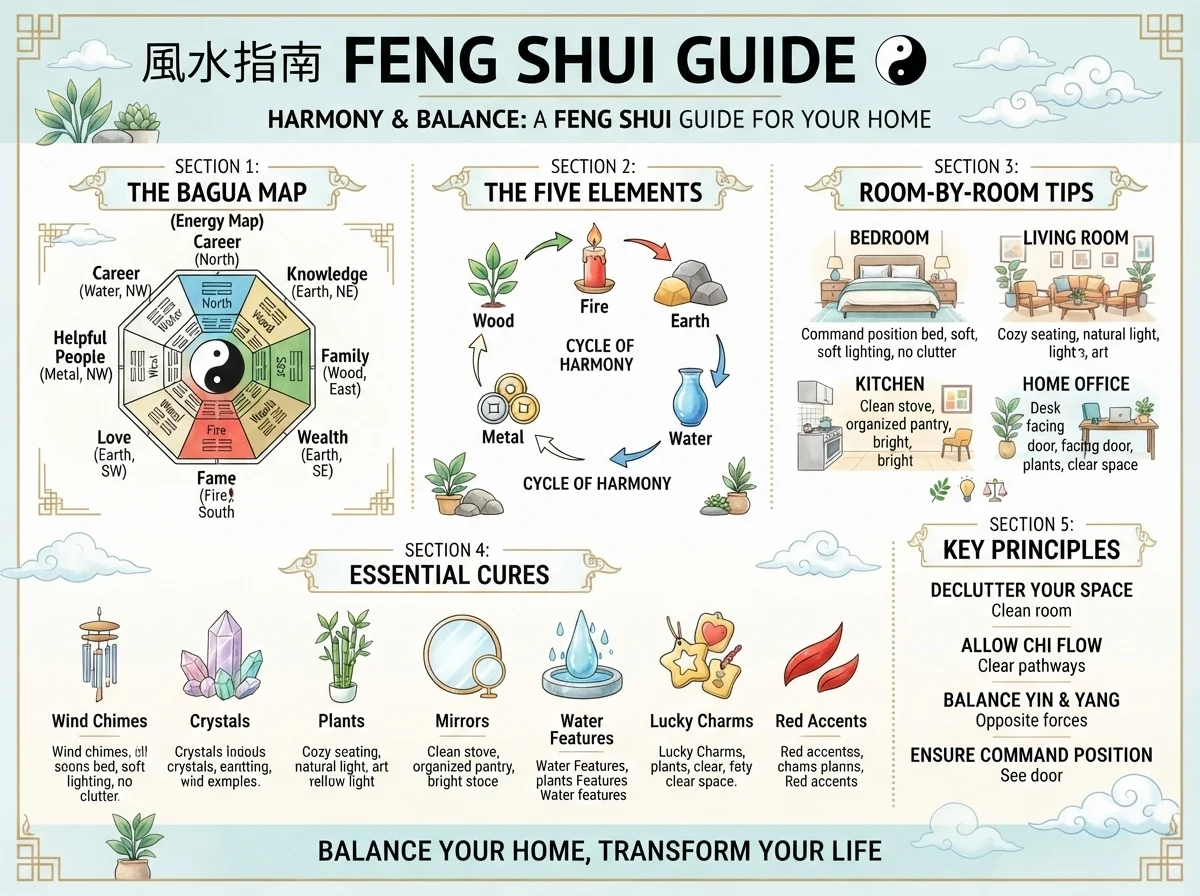
The Five Elements of Feng Shui
The Five Elements are one of the central systems used in traditional Feng Shui.
They are:
Wood
Fire
Earth
Metal
Water
Each element is traditionally associated with particular qualities, colors, shapes, and forms.
Wood
Wood represents growth, development, flexibility, and vitality.
It can be represented through:
Plants
Green colors
Wooden furniture
Tall or vertical shapes
Fire
Fire represents activity, warmth, passion, and transformation.
It can be represented through:
Red and warm colors
Lighting
Candles
Triangular or pointed shapes
Earth
Earth represents stability, grounding, nourishment, and reliability.
It can be represented through:
Natural stone
Ceramics
Beige, brown, and earthy colors
Square or low forms
Metal
Metal is associated with clarity, precision, organization, and structure.
It can be represented through:
Metal objects
White, gray, and metallic colors
Round shapes
Decorative metal features
Water
Water represents movement, adaptability, communication, and flow.
It can be represented through:
Water features
Mirrors
Dark or blue colors
Wavy or irregular forms
The Five Elements are traditionally considered to interact through productive and controlling cycles. Feng Shui practitioners use these relationships to help balance different areas of an environment.
Understanding the Bagua
The Bagua is a Feng Shui framework used to understand different areas of a space and their traditional associations.
Depending on the school of Feng Shui, the Bagua may be applied differently. One commonly used system divides a space into nine areas associated with themes such as:
Wealth and Prosperity
Fame and Reputation
Love and Relationships
Family
Health and Center
Children and Creativity
Knowledge and Self-Cultivation
Career
Helpful People and Travel
The Bagua can be used as a framework for analyzing a home, room, office, or other environment.
It is important to remember that Feng Shui schools do not always agree on exactly how the Bagua should be positioned or interpreted. A professional analysis should therefore identify which Feng Shui method is being used.
Feng Shui and Directions
Directions play an important role in many traditional Feng Shui systems.
The primary directions are:
North
South
East
West
Northeast
Northwest
Southeast
Southwest
Each direction may have different associations depending on the Feng Shui method being used.
For example, some systems connect directions with particular elements, colors, life areas, or forms of energy.
More advanced Feng Shui practices may also consider the precise orientation of a building using a compass measurement rather than relying only on general directional categories.
Feng Shui and the Kua Number
The Kua Number, sometimes called the Gua Number, is a traditional Feng Shui calculation based primarily on a person's birth information and gender according to the particular calculation method being used.
Kua Numbers are commonly used to identify traditionally favorable and less favorable directions for an individual.
These directions may be considered when positioning:
Beds
Desks
Chairs
Workspaces
Main activity areas
However, Kua Number analysis is only one component of Feng Shui. It should not necessarily be used independently to determine the complete Feng Shui condition of a home.
Feng Shui for the Home
A home is one of the most common places where Feng Shui principles are applied.
Entrance
The entrance is traditionally considered important because it is the primary point through which people enter the home.
A Feng Shui-friendly entrance should ideally be:
Clean
Uncluttered
Well maintained
Adequately illuminated
Easy to access
Avoid allowing shoes, boxes, rubbish, or unnecessary objects to accumulate around the entrance.
Living Room
The living room should provide a comfortable environment where people can communicate and relax.
Consider:
Maintaining a clear walking path
Avoiding excessive clutter
Providing comfortable seating
Maximizing natural light
Maintaining good ventilation
Furniture should ideally create a sense of stability rather than making the room difficult to move through.
Bedroom
The bedroom is associated with rest and recovery.
Traditional Feng Shui recommendations often include:
Positioning the bed in a stable location
Keeping the area underneath the bed reasonably clear
Reducing excessive electronic stimulation
Using calming colors
Maintaining a peaceful environment
The bedroom should prioritize comfort and quality sleep rather than excessive decoration.
Kitchen
The kitchen is traditionally associated with nourishment and the Fire element.
Keep cooking areas clean and functional. Avoid unnecessary clutter, and maintain good ventilation.
From a practical perspective, cleanliness and safety should always take priority over Feng Shui symbolism.
Bathroom
Bathrooms should be kept clean, dry, and well ventilated.
Repair leaking fixtures promptly and avoid allowing moisture or unpleasant odors to accumulate.
Good maintenance is one of the simplest ways to improve the overall quality of a living environment.
Feng Shui for the Office
Feng Shui can also be applied to workplaces.
A well-organized workspace can support concentration and productivity by reducing visual distractions and creating a comfortable working environment.
Consider:
Keeping the desk organized
Maintaining sufficient lighting
Providing a comfortable chair
Avoiding unnecessary clutter
Ensuring adequate ventilation
Positioning the desk where you feel secure and comfortable
Some Feng Shui systems also consider the user's Kua Number and the direction in which the person faces while working.
The Importance of Decluttering
One of the easiest Feng Shui practices is simply removing unnecessary clutter.
Clutter can make a space feel crowded and difficult to maintain. It may also block movement and reduce the practical usability of a room.
Start with areas that are used frequently:
Entrance
Living room
Bedroom
Kitchen
Workspace
Storage areas
Rather than attempting to reorganize an entire home at once, work through one area at a time.
Natural Light and Ventilation
Good environmental conditions are important regardless of whether Feng Shui is being considered.
Natural light can make a room feel more open and pleasant, while good ventilation helps maintain a comfortable indoor environment.
Where practical:
Open curtains during the day
Keep windows clean
Allow fresh air to circulate
Avoid blocking windows unnecessarily
Use appropriate artificial lighting when natural light is limited
These practical improvements can complement traditional Feng Shui principles.
Plants in Feng Shui
Plants are commonly used in Feng Shui because they are traditionally associated with the Wood element, growth, and vitality.
Healthy plants can also improve the appearance and atmosphere of a room.
When choosing plants, consider their actual care requirements. A healthy, well-maintained plant is generally preferable to a plant that is unsuitable for the environment and quickly becomes unhealthy.
Avoid overcrowding a room with plants simply because they are associated with positive symbolism.
Mirrors in Feng Shui
Mirrors are frequently discussed in Feng Shui because they reflect light and images and can visually expand a space.
However, their placement should be considered carefully.
A mirror can be useful when it:
Makes a small room appear larger
Reflects attractive scenery
Improves the distribution of light
Creates visual openness
At the same time, a mirror that reflects clutter or an uncomfortable visual feature may make the space feel busier.
The practical effect of the mirror should therefore be considered alongside traditional Feng Shui interpretations.
Feng Shui and Personal Destiny Analysis
More advanced Feng Shui and Chinese metaphysical systems may combine environmental analysis with personal information.
Depending on the tradition, practitioners may use systems such as:
Kua Number
BaZi
Flying Stars
Zi Wei Dou Shu
Five Elements analysis
Chinese zodiac
Other traditional calculation methods
These systems serve different purposes and should not automatically be treated as interchangeable.
For example, BaZi focuses on a person's birth information and traditional Chinese calendrical principles, while Feng Shui primarily examines the relationship between people and their physical environment.
Flying Stars Feng Shui
Flying Stars Feng Shui, also known as Xuan Kong Fei Xing, is a more advanced Feng Shui system.
It considers factors including:
Building orientation
Time periods
Directional sectors
Traditional star combinations
Changes over time
Unlike simple decorative Feng Shui, Flying Stars analysis generally requires accurate information about a property's orientation and construction period.
For this reason, advanced Flying Stars analysis should be approached systematically rather than based solely on general Feng Shui tips found online.
Common Feng Shui Mistakes
Several common mistakes can reduce the usefulness of a Feng Shui approach.
Following Every Rule Literally
Feng Shui contains many traditions and different schools. Not every rule applies universally.
Excessive Use of Symbols
Adding large numbers of symbolic objects does not automatically create good Feng Shui.
Ignoring Practical Considerations
Safety, cleanliness, ventilation, lighting, comfort, and functionality should never be sacrificed for Feng Shui symbolism.
Using One Method for Everything
Kua Number, Bagua, Flying Stars, BaZi, and other systems have different purposes. Combining them without understanding their underlying methods can produce confusing results.
Creating Fear
Feng Shui should be used as a framework for improving the environment, not as a reason to become anxious about ordinary household objects or directions.
A Simple Feng Shui Checklist
You can begin with these basic steps:
Keep the entrance clean and welcoming.
Remove unnecessary clutter.
Maintain good lighting.
Improve natural ventilation.
Keep broken items repaired or removed.
Arrange furniture to create comfortable movement.
Create a peaceful bedroom.
Keep the kitchen clean and organized.
Use plants appropriately.
Consider colors and materials in relation to the Five Elements.
Identify important directions when using a directional Feng Shui system.
Consider your personal Kua Number if appropriate.
For advanced analysis, obtain accurate building orientation and construction information.
How to Begin Your Feng Shui Journey
Feng Shui does not have to begin with complicated calculations.
Start by observing your environment.
Ask yourself:
Does the entrance feel welcoming?
Can energy and people move comfortably through the home?
Is the space excessively cluttered?
Are the bedroom and workspace comfortable?
Is there enough natural light and ventilation?
Are the Five Elements reasonably balanced according to the Feng Shui method you are following?
Once the fundamentals are understood, you can explore more advanced systems such as Kua Number analysis, Bagua, Flying Stars, BaZi, and other traditional Chinese metaphysical practices.
Conclusion
Feng Shui provides a traditional framework for understanding the relationship between people, spaces, directions, and environmental conditions.
The most useful approach is to combine traditional principles with practical common sense. A clean, organized, comfortable, well-lit, and well-maintained environment provides a strong foundation before moving into more advanced Feng Shui calculations.
Whether you are interested in improving your home, designing a workspace, understanding your favorable directions, or exploring advanced Feng Shui systems, learning the fundamental principles is the best place to begin.
Feng Shui should ultimately be viewed as a tool for creating greater awareness of our surroundings and encouraging harmony, balance, and thoughtful use of space.